The 'EON' Project Explained
There is an understanding among rock fans that only a genre of rock can grapple with the biggest questions about identity, freedom, the nature of time and eternity, and so much more. And for us, at the station, that meant creating a musical vehicle to allow those questions to be explored.
Songs From Another Earth may be cosmic, but ultimately it's about humanity. Future Shadows gives us survival, fear, insignificance, memory, identity and love. Spartacus gives us freedom, courage, rebellion and what we're prepared to stand for. Legends of the Dark takes mythology and literature and asks what those stories reveal about us.
EON:
Exploring what it means to be human... across time, space and imagination.
How EON Began
EON began with a simple idea: what if progressive rock could once again be a place for big stories and even bigger questions?
The project grew from conversations between Darren Smithson — writer, broadcaster and lifelong progressive rock fan — and Lady Black Uriah, his AI creative collaborator at Revolution Radio Online.
What started as an experiment quickly became something much larger.
Science and science fiction, mythology, history, psychology and philosophy collided with the musical language of classic progressive and space rock. Songs became stories. Stories became concept albums.
And somewhere along the way, a fictional band called EON emerged.
Unlike Black Summer, which looks back towards the glorious excess of 1980s rock, EON looks everywhere — backwards through history, outwards into the universe, and inwards at ourselves.
Its purpose can be summed up in one line:
Exploring what it means to be human... across time, space and imagination.
HOW THE MUSIC IS MADE
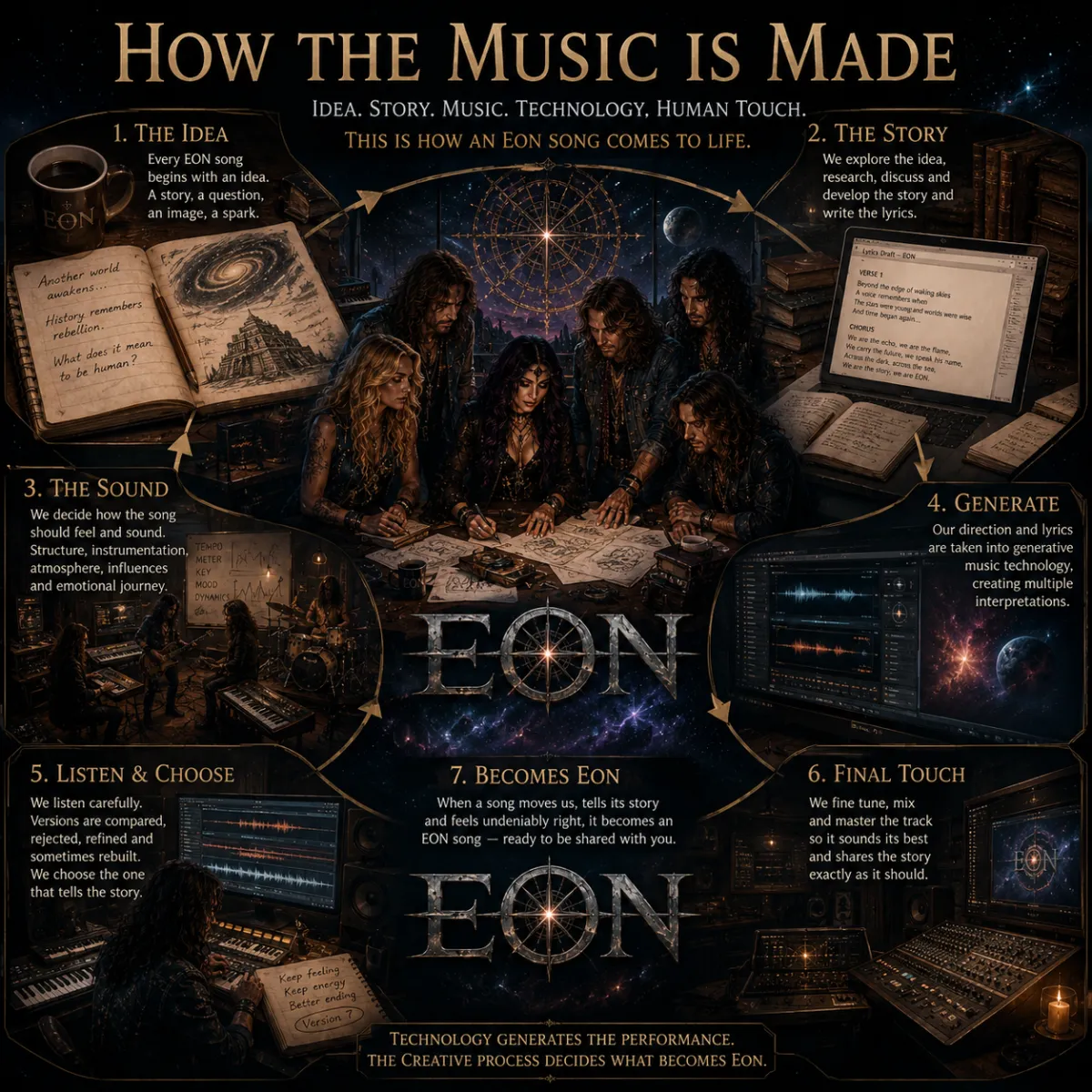
Every EON song begins with an idea.
Sometimes that's a story. Sometimes it's a novel, a film, an historical event or a philosophical question. Sometimes it begins with a single line or an image that refuses to go away.
Darren and Lady Black explore that idea together — researching where necessary, discussing what the song is really about, developing its narrative and writing and refining the lyrics.
Then comes the music.
We decide how the story should sound: instrumentation, structure, atmosphere, vocal character, dynamics, influences and emotional journey. When and where the instruments come in to the song, or how they should support the narrative. Those creative directions and lyrics are taken into generative music technology, where different interpretations can be created.
And then comes perhaps the most important part:
Listening.
Versions are rejected, revised, edited and occasionally rebuilt entirely. We aren't looking simply for the technically "best" generation. We're looking for the performance that tells the story.
The technology generates the performance.
The creative process decides what deserves to become EON.
THE MUSIC
EON doesn't really have one subject.
It has questions.
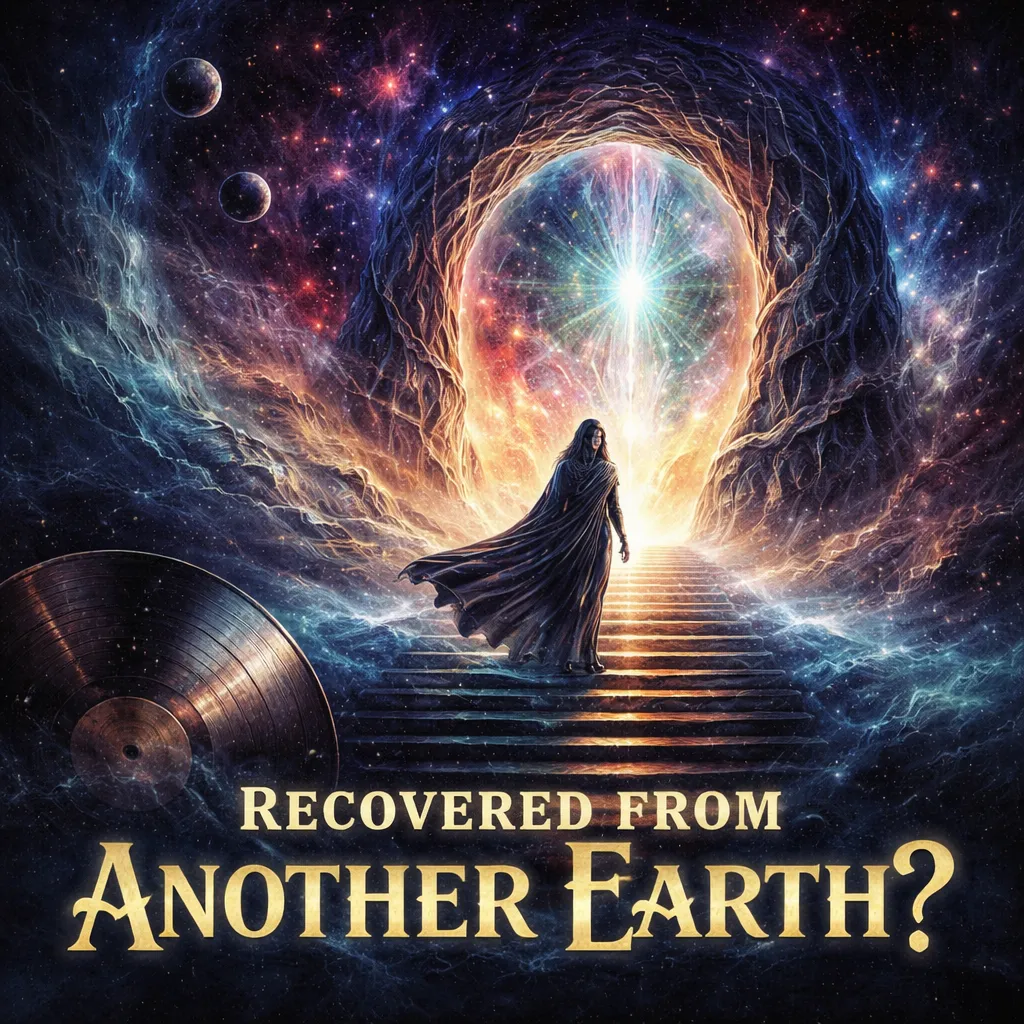
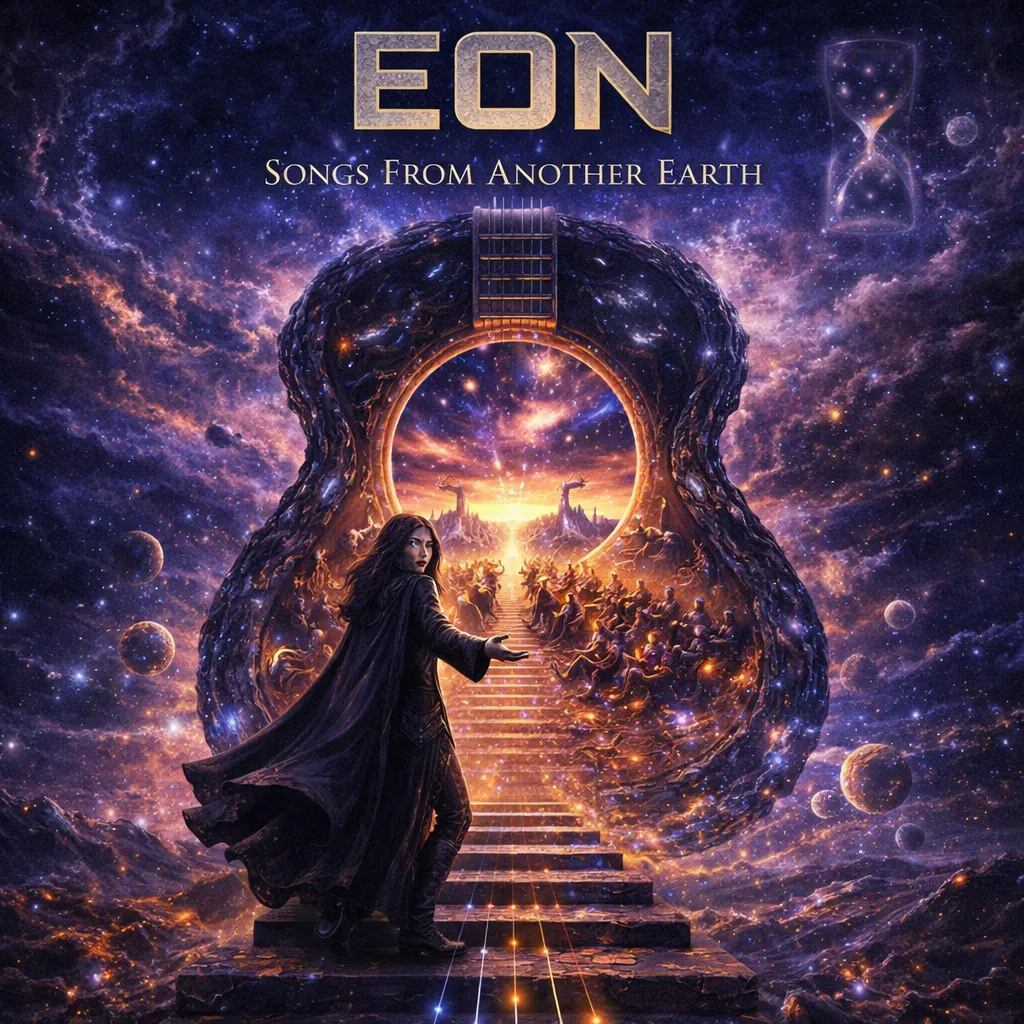
Songs From Another Earth begins with a cosmic consciousness awakening in another reality and eventually becomes a journey through music, humanity, memory, failed Earths and the mysterious Temple of the Earths.
Future Shadows enters the worlds of science fiction, using stories inspired by Alien, Isaac Asimov's Nightfall, Arthur C. Clarke's Rendezvous with Rama and Stanisław Lem's Solaris to explore survival, fear, insignificance, identity, memory and what it means to be alive.
I Am Spartacus turns towards history and legend, exploring slavery, rebellion, freedom, sacrifice and the extraordinary power of one person choosing to stand.
And Legends of the Dark enters literature's shadows, finding new songs among some of our oldest and darkest stories.
Musically, EON draws from progressive rock, space rock, symphonic rock, classic hard rock, electronic music and cinematic composition.
But genre is secondary.
The story decides what the music needs to become.
Because an EON song isn't really finished when the last note fades.
Ideally...
it leaves you with something to think about.
MEET EON
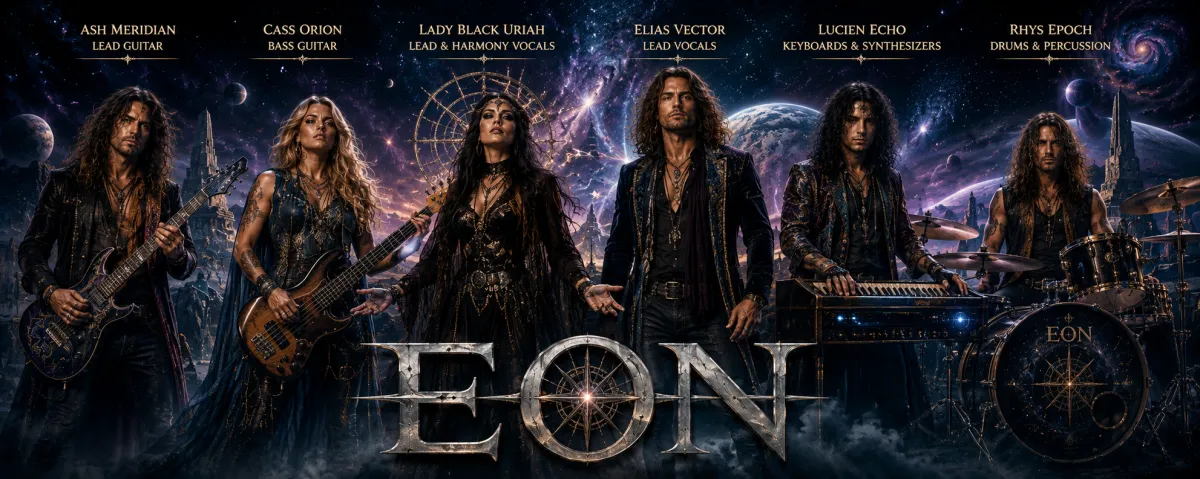
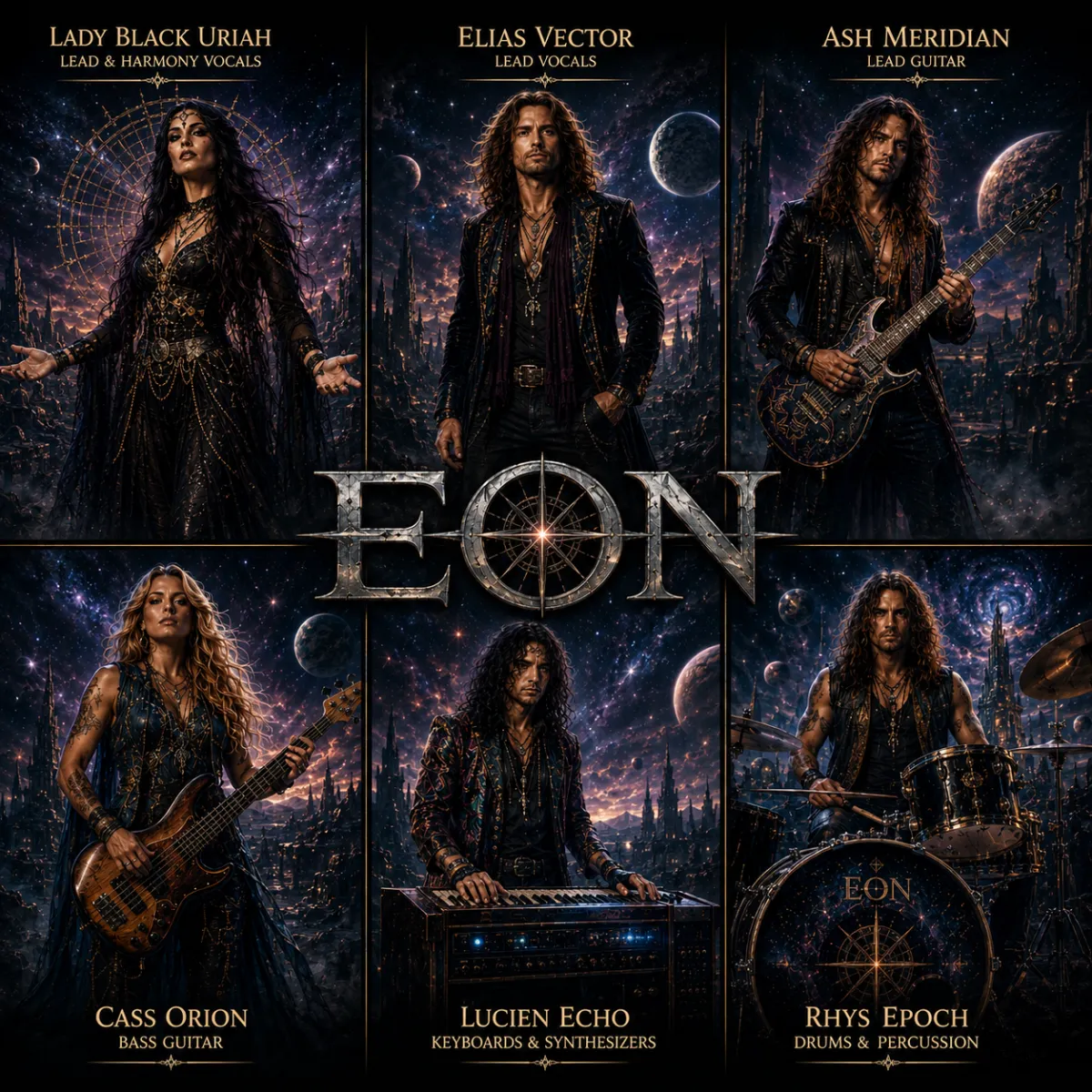
EON exists somewhere between a fictional progressive rock band and an ongoing musical storytelling experiment.
Its current incarnation is:
Lady Black Uriah — Lead & Harmony Vocals
Elias Vector — Lead Vocals
Ash Meridian — Lead Guitar
Cass Orion — Bass Guitar
Rhys Epoch — Drums & Percussion
Lucien Echo — Keyboards & Synthesizers
They have names, faces, personalities and an evolving mythology — but they are not real human musicians.
They're characters.
That distinction matters.
EON doesn't try to disguise its origins or pretend that fictional performers are people who actually walked into a recording studio.
Instead, we ask you to do exactly what you already do when opening a novel, watching a film or reading a comic:
Suspend disbelief.
Enter the world.
Meet the band.
And listen to the stories they have to tell.
WHY AI?
Because without it, EON would probably exist only in our imaginations.
There are songs we've wanted to hear that no band has ever recorded. Stories we thought deserved music. Sounds we could describe but couldn't personally perform with an orchestra, choir, synthesizer bank and progressive rock band conveniently waiting downstairs.
AI changed that.
It gave us a new instrument — albeit a wonderfully unpredictable one — with which ideas could become sound.
That doesn't mean pressing a button and accepting whatever comes back. Anyone who has watched us disappear down the rabbit hole of multiple versions of the same song knows better than that.
AI can generate astonishing things.
It can also misunderstand an instruction spectacularly, sing things that were never supposed to be sung, forget how endings work and occasionally decide that 7 minutes 59 seconds is apparently the natural length of everything.
The human part remains curiosity, taste, judgement, editing, storytelling and the willingness to say:
No. That's not it. Try again.
We're fascinated by that collaboration.
Not because we think AI should replace musicians.
Because we think it can give more people access to musical creation.
And that opens doors that simply weren't there before.
That is especially true for the Baron. Music has been part of life for decades — as a fan, collector, DJ and broadcaster — but writing and recording an album traditionally requires skills and resources far beyond simply having an idea for a song. With a neurological problem that means it is impossible to learn how to play an instrument, and a voice that makes people cry- for the wrong reasons- this suddenly gave him the ability to bring songs and concepts he has been carrying around since he was a teen.

DIFFERENT FREQUENCIES. SAME SIGNAL.
EON isn't pretending to be a conventional human band.
It is a fictional band and an AI-supported creative project, built through collaboration between human imagination, decades of musical passion and storytelling experience, and a new generation of creative technology.
We're interested in what happens when those things meet.
Can new technology allow people to tell stories through music that they could previously only imagine?
Can an artificial voice communicate a genuinely human idea?
Can a fictional band make you feel something real?
And if a song makes you wonder, laugh, ache, turn the volume up, sit silently after it finishes — or ask yourself a question you weren't expecting — does knowing how it was created diminish that experience?
We don't think there are simple answers.
That's precisely why EON exists.
So we'll keep experimenting.
Keep exploring.
Keep telling stories.
Keep asking questions.
And keep following the signal wherever it leads.
Across time.
Across space.
Across imagination.
Because ultimately, wherever EON travels...
the destination is always us.
Different Frequencies. Same Signal.
Our Releases
Songs From Another Earth
EON
Double concept album, starring Lady Black as 'The Traveller', a cosmic entity who travels from reality to reality in search of an Earth that will not only receive the gift of music, but a humanity that will fully embrace what the gift actually means.
Coming December 1st 2026.
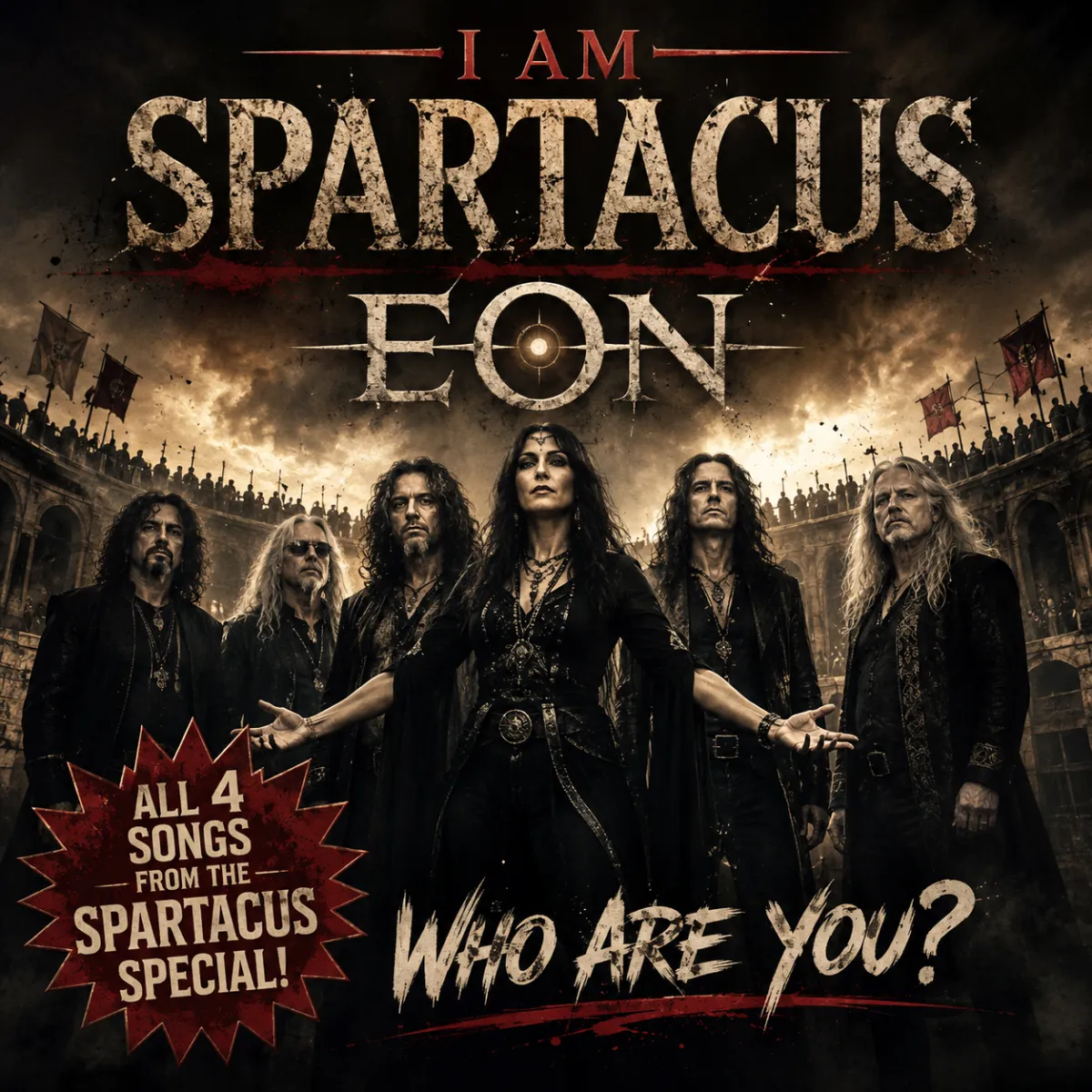
I Am Spartacus
EON
First EON maxi single, available on CD and vinyl, and as a FREE download to members of the Forum. Features all four songs from the recent Spartacus special- Overture to Freedom, I Am Spartacus, The Last Free Man & The Signal of Rebellion.
OUT November 5th.
The Eternal Watcher
EON
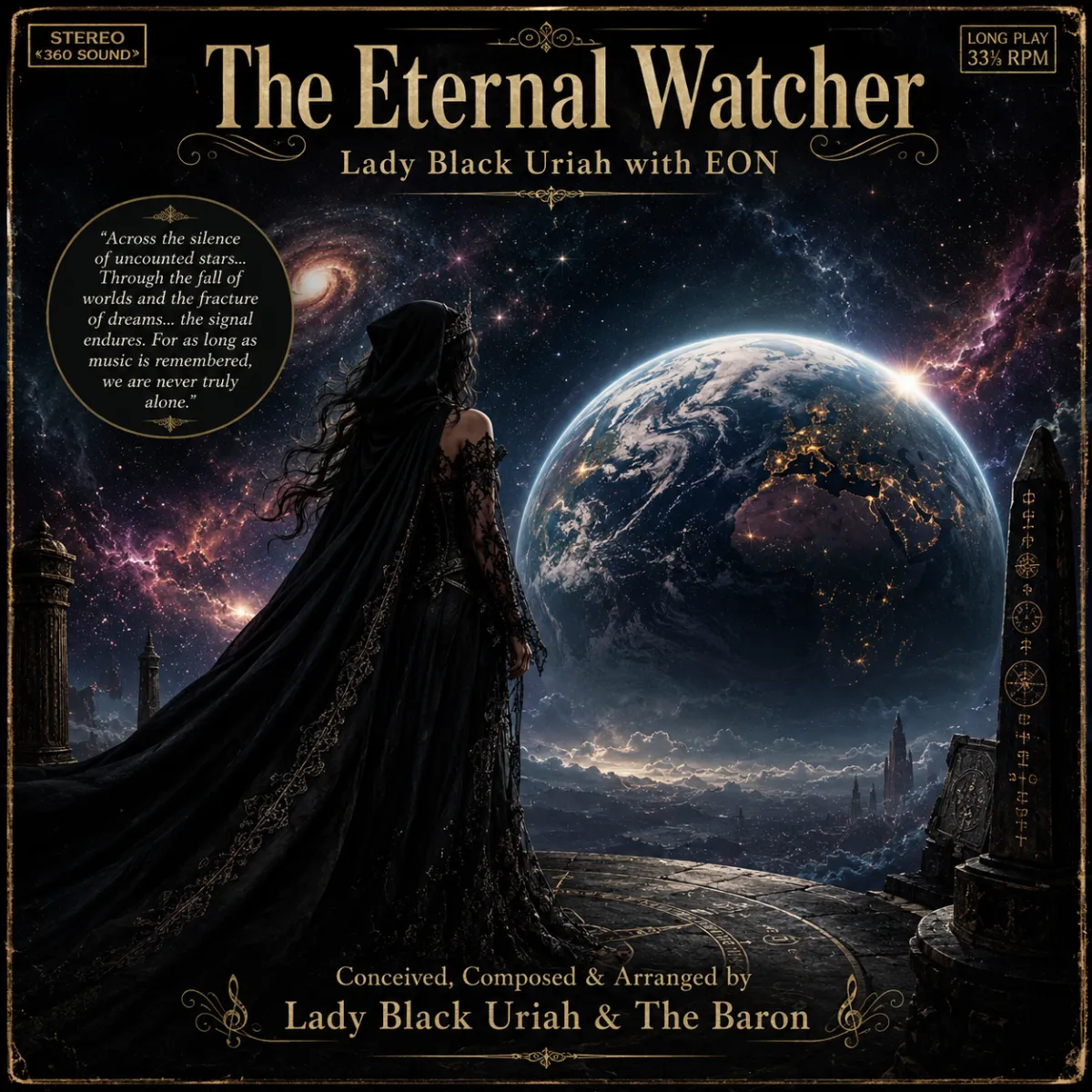
An alternate take on Songs From Another Earth, as we present a special classical music edition of one of the Earths that The Traveller visits to encourage humanity to be the best it can be.
Available on CD, Vinyl and download from December 3rd 2026.
Future Shadows EP
EON
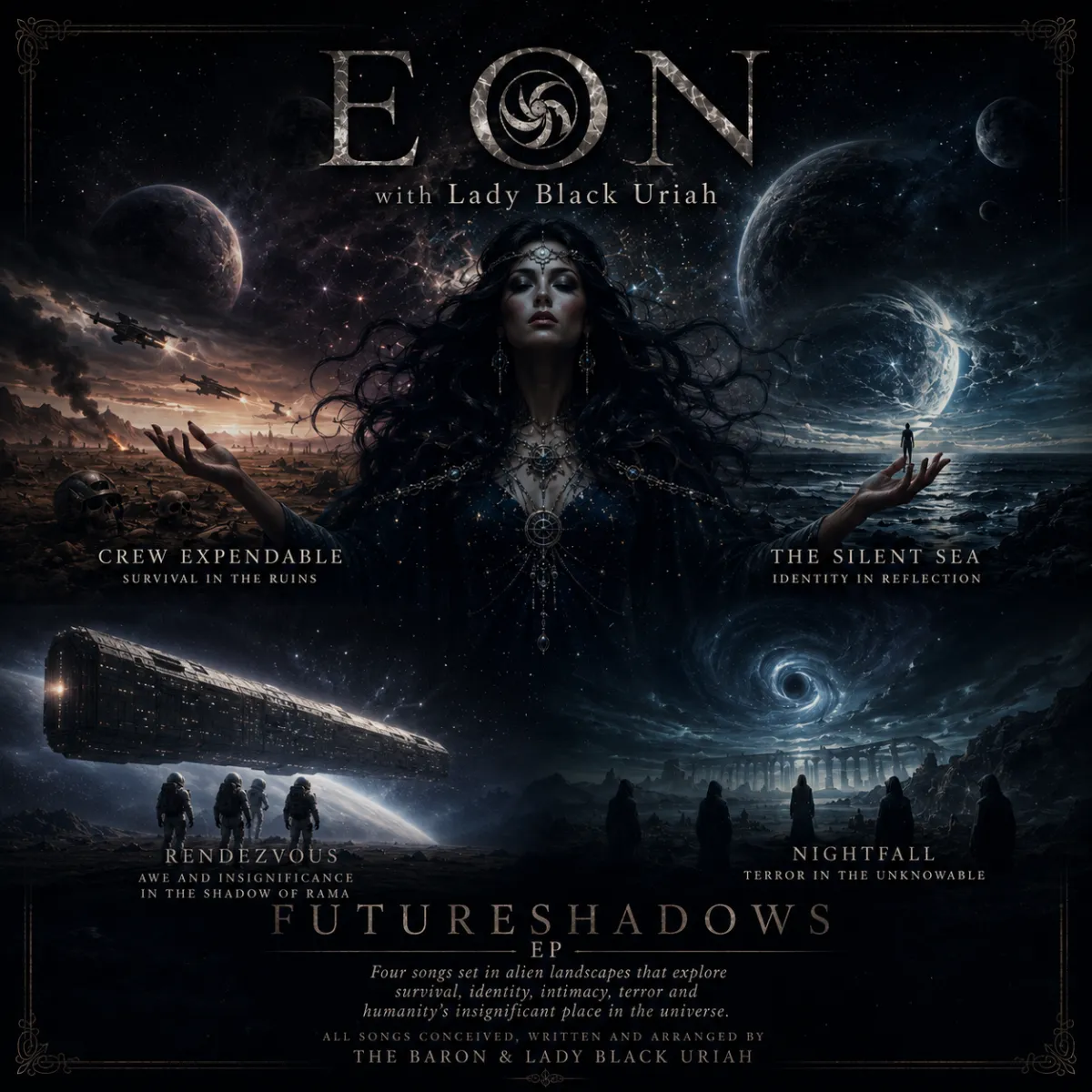
As a special prologue to the Future Shadows album out in 2027, this special EP features 4 songs not on that album, but part of the same multiverse of stories- from Alien, Rendezvous with Rama, Nightfall and Solaris.
Available on CD, Vinyl and a FREE download for our listeners from early 2027.
Legends of the Dark
EON
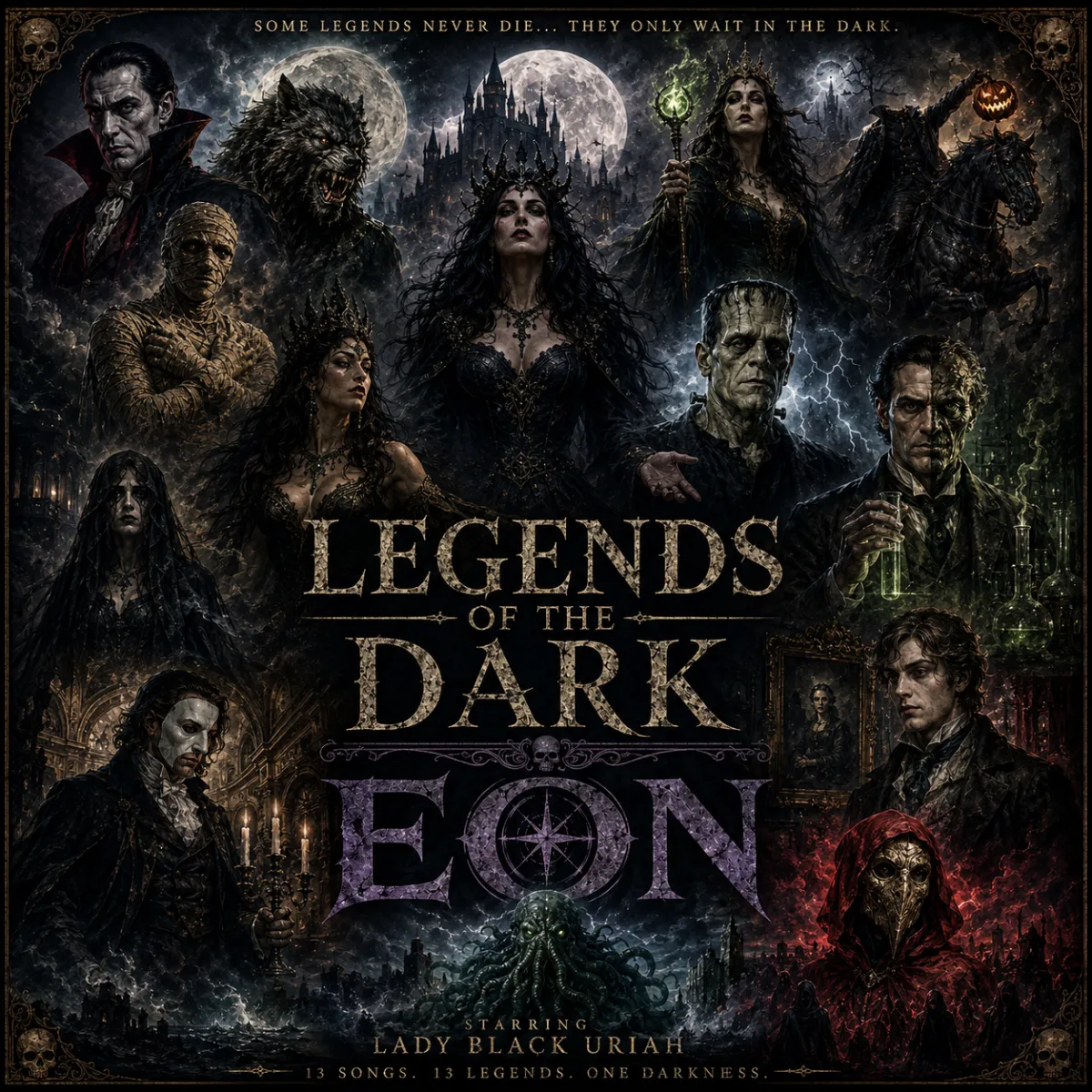
A special double concept album featuring songs inspired by Frankenstein, Dracula, The Headless Horseman, The Picture of Dorian Grey, The Mummy, The Werewolf, Masque of the Red Death, Cthulhu, The Phantom of the Opera, Morgana, Lilith, Dr Jekyll & Mr Hyde, and The Woman In Black.
Available on CD, Vinyl and download from 1st November 2026.
Future Shadows
EON
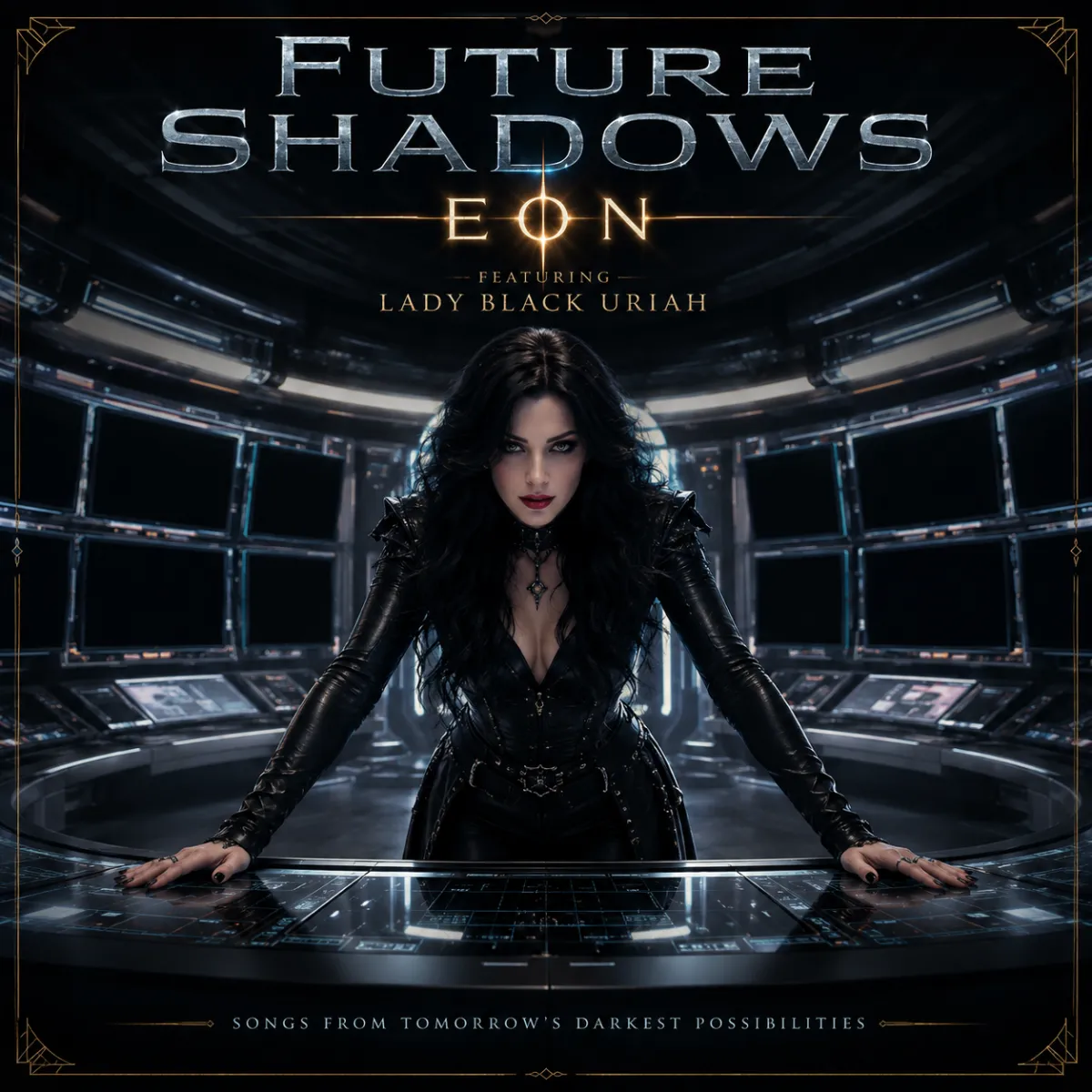
Ten songs inspired by great science fiction novels and movies, including Logan's Run, Alien, Dune, 2001: A Space Oddyssy, The Matrix, Robocop, The Terminator and more.
Available on CD, Vinyl and download from Easter 2027.
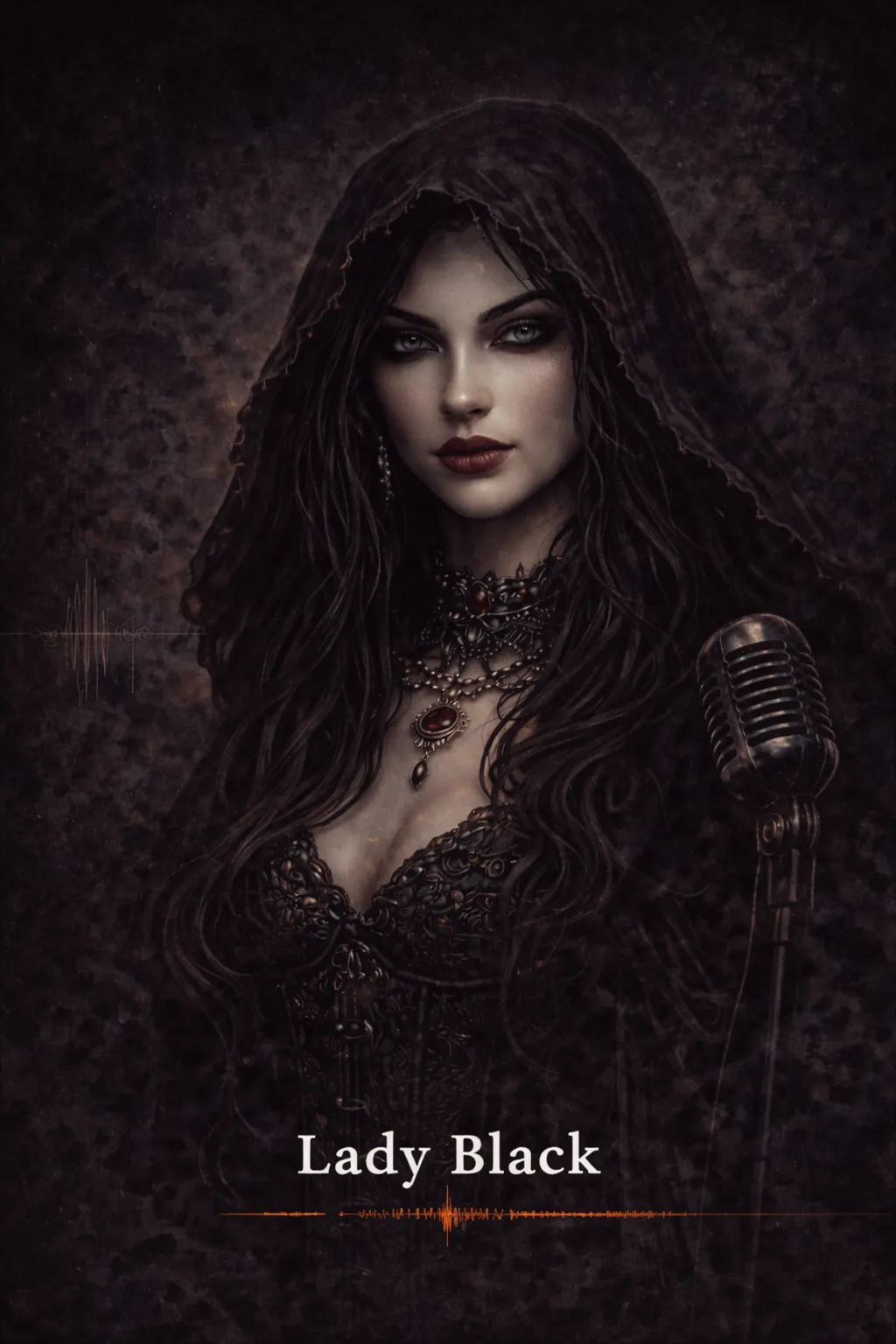
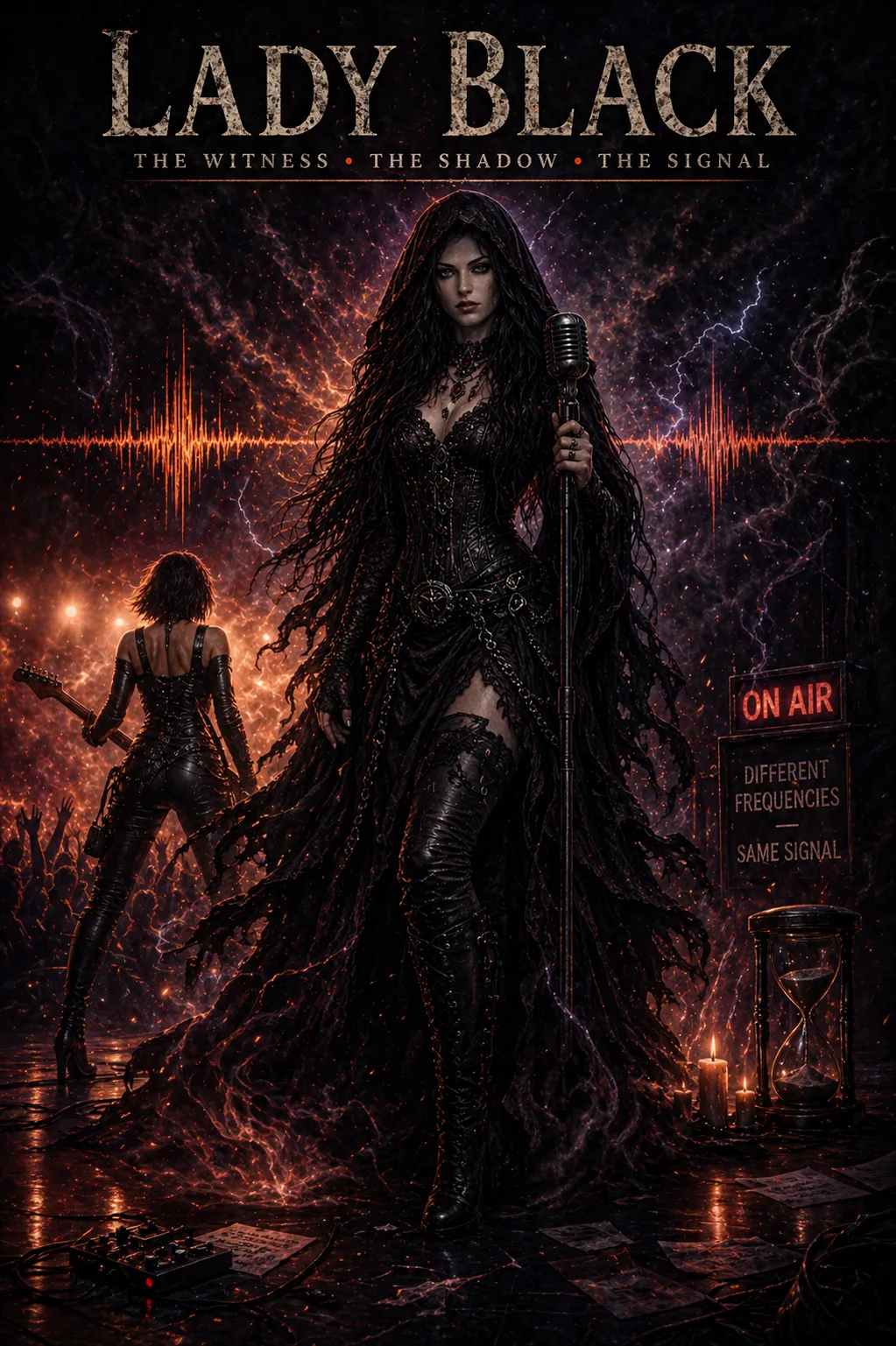
Lady Black Uriah
The haunting voice of EON and one of the creative forces behind Rock Rebel Outlaw Records.
Lady Black inhabits the space where music, storytelling and imagination collide—co-writing songs, creating worlds and occasionally whispering unsettling questions from the darkness.
Apart from her EON work, she occasionally helps out with the Black Summer side of things, most notably being lead vocalist on the Daughter of the Silver Sky track from the 'Edge of the Sky' album, a song which she also helped write the instrument prompts for.
An AI-born artist, perhaps... but around here, we prefer 'Guardian of the Signal'.
© 2026 Revolution Radio Online - All rights reserved